True Temper / Kelly
Kelly Axe Mfg. Co. → American Fork & Hoe Co. → The True Temper Corporation
For more than a century the Kelly Axe Manufacturing Co. was the largest axe maker in the world — its Charleston, West Virginia works was known in the trade as “the world’s largest axe factory.”T4 Its lines — Kelly Perfect, Flint Edge, the collectible Black Raven, and eventually True Temper itself — set the pattern for the American single-bit axe. This page traces the company from its 1874 Kentucky start,T3 lays out the ladder of brands it stamped onto near-identical heads, and shows how to date a head by its stamp.
A short history
The Kelly Axe Manufacturing Company began in 1874 at Eddyville, Kentucky, where William C. Kelly set out to make a better single-bit axe.T3 The idea that carried the firm was a fully machine-ground, mirror-polished bit — sold from 1887 as the “Kelly Perfect” — which set a house style the company kept for a century.T7 The works moved to Alexandria, Indiana by 1897, and in 1904 to Charleston, West Virginia, where it grew into what the trade called “the world’s largest axe factory.”T3T4
Consolidation then reshaped the tool industry. In 1902 seventeen firms merged to form the American Fork & Hoe Company of Cleveland,T5 which bought Kelly in July 1930 and ran the Charleston plant as its axe division.T3 When American Fork & Hoe renamed itself The True Temper Corporation in 1949,T5 “True Temper” became the umbrella over the old Kelly lines — a handover you can still read on the heads themselves (see dating, below). Charleston kept forging axes until production ceased in 1983.T3
Kelly steel remains among the most recognizable on the American vintage market, and the firm’s premium etched lines — above all the Black Raven — are among the most sought-after axes collectors chase today. Because a single factory sold near-identical heads under a whole ladder of brand names, a Kelly axe can turn up stamped a dozen different ways — which is exactly why the marks are worth learning.
Corporate genealogy
The “brand over time” spine — one axe lineage under three corporate names. Dates from the West Virginia Encyclopedia and company history (T3–T5); the 1938 catalog is the primary anchor.
- 1874Kelly Axe Manufacturing Co. founded by William C. Kelly at Eddyville, KY. ~ T3
- by 1897Relocated to Alexandria, IN. ~ T3
- 1904Relocated to Charleston, WV, growing into “the world’s largest axe factory.” ~ T4
- 1902American Fork & Hoe Co. formed by the merger of 17 tool-making firms (Cleveland, OH). ~ T5
- Jul 1930American Fork & Hoe acquires Kelly — the “Kelly Works” becomes its axe division. ~ T3
- 1938True Temper General Catalog No. 1-R documents the full axe line. ✓ T1
- 1949American Fork & Hoe renamed The True Temper Corporation. ~ T5
- 1983Axe production at Charleston ceases. ~ T3
Market positioning & the quality ladder — one head, four grades · 1938
Kelly’s brands were not so much different axes as different grades of the same axe: one forged head, separated by how far the bit was ground and polished and how the poll was finished, then named and priced accordingly.T1 Weights below are head weights; handles 36″ hickory unless noted — from the dated 1938 catalogT1 and its companion spec book,T2 verified against the scans.
| Line | Grind & finish | Single-bit patterns & weights | Double-bit | Also sold as |
|---|---|---|---|---|
| Kelly Perfect premium · top of lineintroduced 1887 | Full ground, full mirror polish; deep bevels painted blue | Dayton 3–4½ · Michigan 3–4 · Jersey 3–4½ · Kentucky 3½–4 lb | Michigan 3–3½ · Western 3–4 lb | — |
| Red Warrior high | Full ground, mirror-polished bit & top; poll painted red | Dayton 3–5 · Michigan 3–4 · Connecticut 3–3½ · Jersey 3–4½ · Kentucky 3½–5 lb | Michigan (2½ Cruiser, 28″) · Michigan · Western · Reversible | World’s Finest |
| Flint Edge standardintroduced 1895 | Full ground, edge & top polished; permanent black finish | Dayton 3–5 · Michigan 3–4 · Connecticut 3–3½ · Jersey 3–4½ · Kentucky 3½–5 lb | Michigan (2½ Cruiser) · Michigan · Western · Reversible | Vulcan |
| Woodslasher / Champion economy | Quarter ground; top ground, edge polished; red / black; white-lacquer handle | Dayton 3–4 · Michigan 3–4 · Jersey 3–4 · Kentucky 3½–4 · Connecticut 3–3½ lb | single bit only | — |
Special patterns (same catalog): Cedar / “Mexican Cedar” · Coast · Constructors (dock, rafting/mauling) · Miner’s · Pulaski-Mattock · Fireman’s Pick (6 lb) · Undercut (for power saws). ✓ primary
One axe, many names — and where Black Raven fits
Beyond the four grades, the same Kelly steel wore a long list of private labels a jobber could order under his own name. The 1938 catalog prints them together:T1
Explicit equivalences in the catalog text: Red Warrior = World’s Finest, Flint Edge = Vulcan (“when specified”). ✓ primary
How does Black Raven compare? Introduced around 1904,T6 it was Kelly’s showcase etched line, carrying the raven that makes it unmistakable. The 1938 catalog leads both its single- and double-bit axe columns with Black RavenT1 — the range’s flagship brand — and among collectors today it is the most prized Kelly axe of all. ✓ 1938 catalog ~ collectibility today
Dating a head by its stamp — the collector’s first question
You hold a stamped head and want a year. Two levers combine: the maker’s-mark era (what the stamp says) brackets a span, and the brand’s introduction date sets the earliest it could be. Mark chronology from a collector dating guide (T6), cross-checked against the corporate record (T3–T5) and the trademark filings (T8).
| Era | The mark — illustration & wording | What it tells you |
|---|---|---|
| 1874–1896 | Kelly Axe Mfg. Co. · Louisville / KY | Founding era, Kentucky. |
| 1896–1904 | Kelly Axe Mfg. Co. · Alexandria, IND | The Indiana years — a strong, specific bracket. |
| 1904–1924 | Kelly Axe Mfg. Co. / Kelly Axe & Tool Co. · Charleston, WV | Moved to WV in 1904 (the “world’s largest axe factory”). |
| 1924–1930 | Kelly Axe & Tool Co. | Kelly now controls the American Axe & Tool Co. |
| 1930–1949 | Kelly Axe & Tool Works (“Co.”→“Works”) | The tell for the American Fork & Hoe era (acquired Kelly Jul 1930). |
| 1940–1949 | True Temper over Kelly Works (transition) | “True Temper” branding creeps onto the head. |
| 1949–1960s | 3-line: True Temper / Kelly Works / Forged Steel | The classic post-rename premium stamp (3-line label from the 1942 catalog, T7). |
| 1960s–70s | True Temper + model name (simplified) | Later, plainer marks. |
| 1970s–1982 | Model name / minimal marks | Wind-down; Charleston axe-making ends 1982. |
Stamp illustrations are original line drawings of each era’s mark wording and layout (copyright-clear), matched to a collector dating guide (T6) and the corporate record — not tracings of any one head. ~ corroborated
| Brand | Introduced | How we know | |
|---|---|---|---|
| Kelly Perfect | 1887 | Design patent No. 327,275 (1885); etch trademark filed 1890 (T7) | ~ |
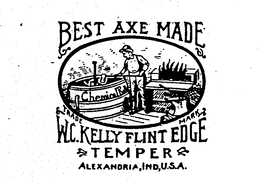
| Flint Edge | 1895 | USPTO “first use anywhere” July 1895; trademark filed Aug 1897 (T8) | ✓ |
| Black Raven | c.1904 | Earliest examples carry the “Kelly Axe Mfg. Co.” mark (1904–24) (T6) | ~ |
| True Temper (farm & garden) | 1907 | American Fork & Hoe trademark registration (T8) | ~ |
| True Temper (axes) | 1931 | AF&H registered “True Temper” for axes/hatchets in 1931, just after acquiring Kelly (1930) (T8) | ~ |
Put them together
Combine the two levers and a bare head gives up its decade:
- A Black Raven stamped Kelly Axe Mfg. Co. → 1904–1924 (brand from ~1904; that company stamp ends 1924).
- A Kelly Perfect stamped Kelly Axe & Tool Works → 1930–1949.
- A 3-line True Temper / Kelly Works / Forged Steel head → c. 1949–1960s.
Axe patterns — the shared vocabulary, from the 1938 plate
Every weight above is one of these named pattern shapes. The catalog’s own silhouette chart (T2, p. 4) is the definitive key — and the same pattern names recur across every American maker, so this doubles as the guide’s master pattern glossary.
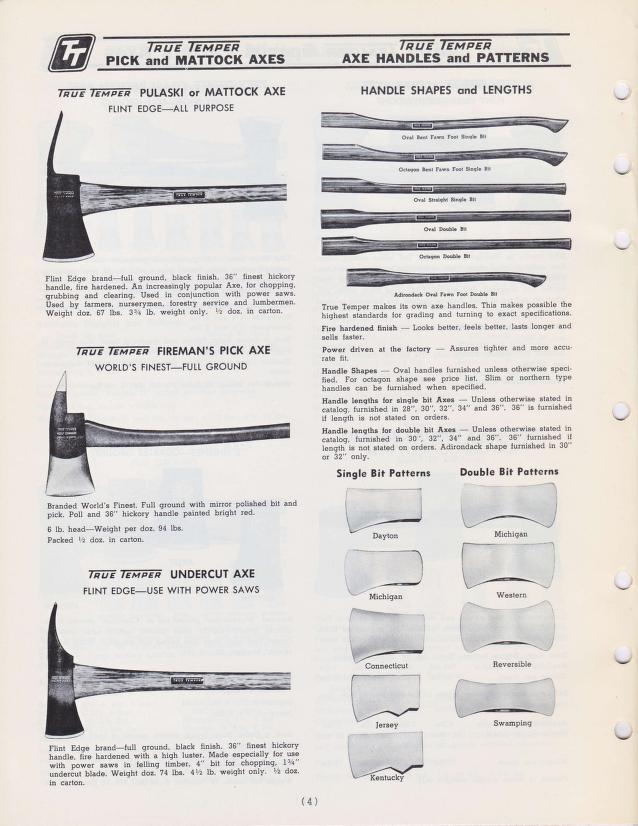
Single-bit patterns
Double-bit patterns
True Temper made its own handles too — oval vs. octagon, straight vs. fawn-foot, 28″–36″ — so a full entry is brand → line → pattern → weight → handle. Every axis on this plate.
In period print
How the Kelly line was sold and talked about in its own day — located in the historic press and trade journals, each quote read on the original page. All are public-domain sources.
“the best known and the most satisfactory axes made.”
An independent Arkansas dealer’s catalog puts its weight behind the line — Kelly Perfect and Flint Edge, $1.25 each.
Leifer Bros. Seed Co. catalog, Little Rock, Ark. (T15)
“the largest single works in the world devoted to the manufacture of axes.”
A plant feature in a national metals-trade journal, with photographs of the eleven grinding rooms.
The Iron Trade Review, Cleveland (T16)
“Kelly Axes. Best axe made.”
A hardware dealer runs the whole ladder with prices — Flint Edge unhandled 50¢ up to the full-polished Kelly Perfect at 95¢.
The Butler Weekly Times, Butler, Mo. (T10)
“Sixty Per Cent of all the Axes Used in the World.”
A hardware-convention report on the Charleston plant — the period claim behind “the world’s largest axe factory.”
The Daily Inter-Mountain, Elkins, W. Va. (T11)
“ask for one of our Kelly Vulcan Axes.”
Priced at $2.25 — a period dealer naming Vulcan as a Kelly line, independent of the 1938 catalog.
The Lynden Tribune, Lynden, Wash. (T12)
…passed off as “genuine Kelley axes.”
A court fight over dealers relabeling surplus axes and misusing the “Flint Edge” mark — a brand worth counterfeiting.
East St. Louis Daily Journal, Ill. (T14)
A note on prices
Neither surviving True Temper catalog lists a dollar figureT1T2 — makers kept net prices in separate dealer lists. What we can date are the street prices hardware dealers advertised: a handled Kelly Perfect around 85–95¢ in 1915,T10 a Kelly Vulcan at $2.25 in 1918,T12 and Flint Edge $2.15 / Kelly Registered $2.35 by 1926T13 (see In period print). These are retail dealer prices, not the maker’s net — but they are named, dated, and real.
What a Kelly is worth today — recent eBay sales
The Kelly lineage — Kelly Perfect, Flint Edge, the etched Black Raven — grew into the world’s largest axe works before American Fork & Hoe folded it into “True Temper.”
Sources
- primary · dated manufacturer catalogPD (non-renewal, likely)
American Fork & Hoe Co. True Temper Tools: General Catalog No. 1-R, 1938 (Copyright 1938, verified). 234 pp. Internet Archive → - primary · manufacturer catalog
American Fork & Hoe Co. True Temper Striking Tools Catalog A57, n.d. [c. late 1930s]. Source of the spec grid; pp. 3–4 verified against the scans. Internet Archive → - secondary · lead
“Kelly Axe and Tool Company.” e-WV: The West Virginia Encyclopedia. wvencyclopedia.org → - secondary · lead
“June 30, 1904: Kelly Axe & Tool Co. Acquires Land to Become World’s Largest Axe Factory.” West Virginia Public Broadcasting. wvpublic.org → - secondary · lead
“Ames True Temper” (corporate history: 1902 merger, 1949 rename). Wikipedia. wikipedia.org → - secondary · dating guide
“How to Date a Kelly Axe” (Decoding Common Kelly Axe Stampings). Houston Axe Mag. — source of the mark chronology; cross-checked vs. corporate & trademark dates. houstonaxe.com → - secondary · research site
“The Birth of the Kelly Perfect Axe” & “The True Temper ‘3 Line Stamps’ of the Kelly Works.” Exploring Axe History. exploringaxehistory.com → - primary · U.S. trademark / patent records
USPTO filings (via Justia Trademarks): Flint Edge first use Jul 1895 (filed 1897); True Temper for axes reg. 1931; True Temper for farm/garden tools 1907; Kelly Perfect design patent No. 327,275 (1885). trademarks.justia.com → - secondary · lead
“True Temper Corp.” Encyclopedia of Cleveland History, Case Western Reserve University. case.edu/ech → - primary · period newspaper advertisementpublic domain
“Kelly Axes. Best axe made.” (dealer advertisement, with price ladder). The Butler Weekly Times (Butler, Mo.), Oct. 14, 1915, p. 4. Library of Congress, Chronicling America → - secondary · period newspaper reportpublic domain
“Big Axe Factory” (hardware-convention report; the “sixty per cent” claim). The Daily Inter-Mountain (Elkins, W. Va.), Feb. 20, 1908, p. 4. Library of Congress, Chronicling America → - primary · period newspaper advertisementpublic domain
“Kelly Vulcan Axes” (dealer advertisement, priced $2.25). The Lynden Tribune (Lynden, Wash.), Jan. 24, 1918, p. 8. Library of Congress, Chronicling America → - primary · period newspaper advertisementpublic domain
Flint Edge Axes $2.15 / Kelly Registered Axes $2.35 (dealer advertisement). The Weekly Gazette (East Hartford, Conn.), Sept. 10, 1926, p. 9. Library of Congress, Chronicling America → - secondary · period newspaper reportpublic domain
Report of a trademark suit over axes passed off as “genuine Kelley axes” and misuse of the “Flint Edge” mark. East St. Louis Daily Journal (Ill.), Jan. 22, 1922, p. 10. Library of Congress, Chronicling America → - secondary · period dealer catalog (endorsement)public domain
“The Kelly Axes are the best known and the most satisfactory axes made.” Seeds of All Kinds, Implements, Hardware, Leifer Bros. Seed Co. (Little Rock, Ark.), 1914, p. 63. Internet Archive → - secondary · period trade journalpublic domain
“A Modern Axe Manufacturing Plant.” The Iron Trade Review, Vol. 34 (Cleveland), Oct. 24, 1901, p. 24. Internet Archive → - secondary · period trade journalpublic domain
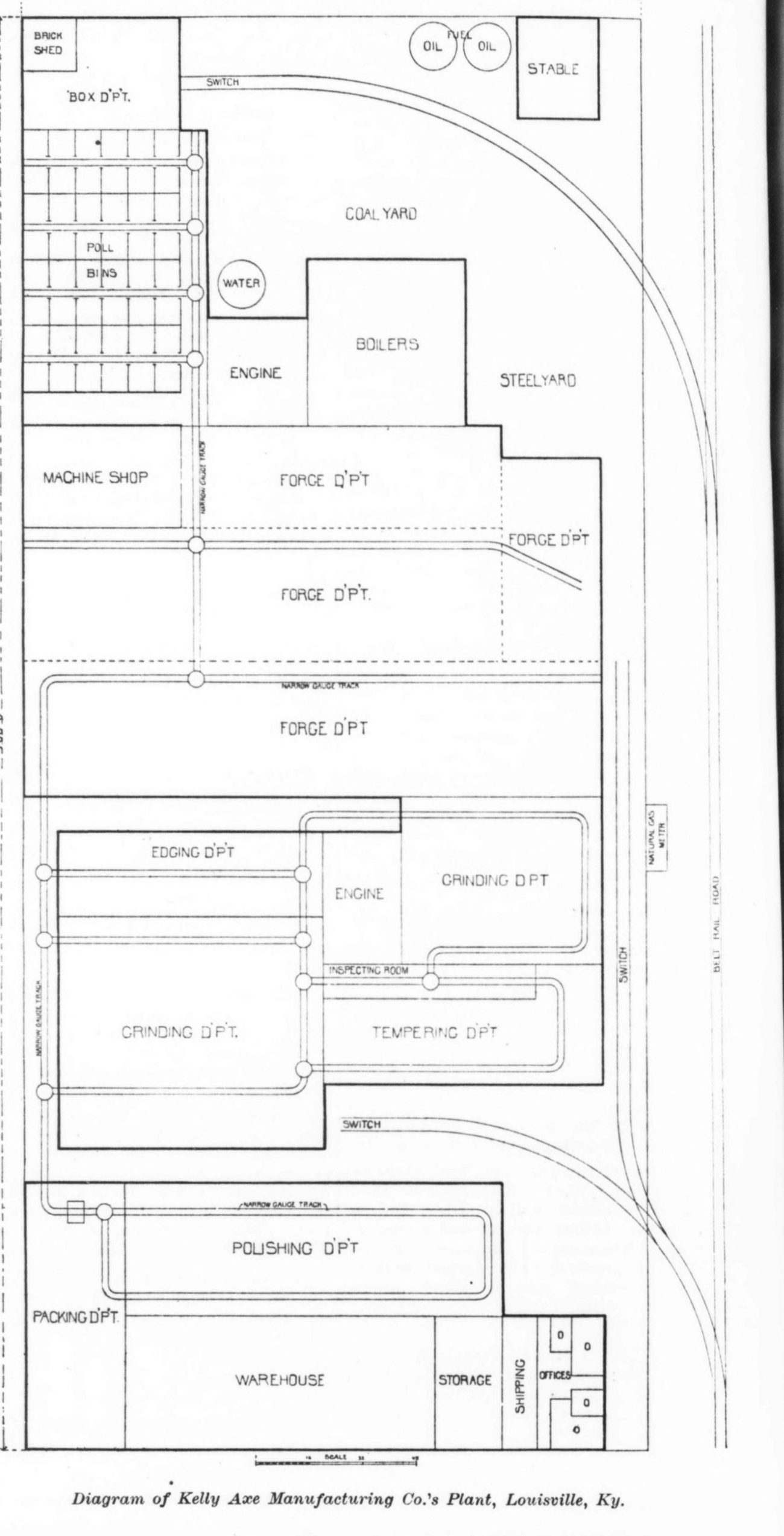
“The Plant of the Kelly Axe Mfg. Company” (feature, with a scale plant diagram). The Iron Age, Vol. 49 (New York), March 17, 1892, p. 530. Internet Archive → - primary · U.S. trademark registration drawingpublic domain
U.S. Trademark Reg. No. 30,835, “W. C. Kelly Flint Edge” (axes) — filed Aug. 16, 1897, registered Nov. 9, 1897. Mark drawing from the USPTO record (a U.S. Government publication). USPTO drawing →
← Other makers: Collins & Co. · Fayette R. Plumb · American Axe & Tool · Mann Edge Tool · Warren / Sager · Douglas Axe · Underhill Edge Tool · Emerson & Stevens · Snow & Nealley · Historic Axe Prices
↑ Home — all makers · Axe head patterns · About the author · How we source · Terms · Privacy · Disclaimer
True Temper / Kelly: the company’s history, its 1938 model line and brand tiers, and a stamp-dating key. Every figure carries a source and a confidence flag. Not affiliated with True Temper, Ames True Temper, or any current rights-holder; sources are digitized trade catalogs (cited for fact) and clearly-marked secondary references.