Collins & Co.
The Collins Company — Collinsville (Canton), Connecticut
Collins & Co. was the first American works built solely to make axes, and for much of the nineteenth century the largest — its Legitimus mark so trusted that it became one of the most counterfeited in the whole tool trade.S1 This page traces the firm from its 1826 founding at Collinsville to its close in 1966, lays out what it made and what it charged, and shows how to date a Collins head by its stamp.
A short history
Collins & Co. is, in a real sense, where the American factory axe begins. Founded in 1826 on the Farmington River at Collinsville, Connecticut, it was the first American works built solely to make axes, and for much of the nineteenth century the largest.S1 Where a village smith might turn out a few axes a week, Collins forged with trip-hammers from 1828 and was soon making axes by the hundred thousand a year.S1S6 Its edge held because of what collectors still call “the Collins way” — a tool-steel bit split into the poll and forge-welded deep, not merely lapped over the cheaper way.S1
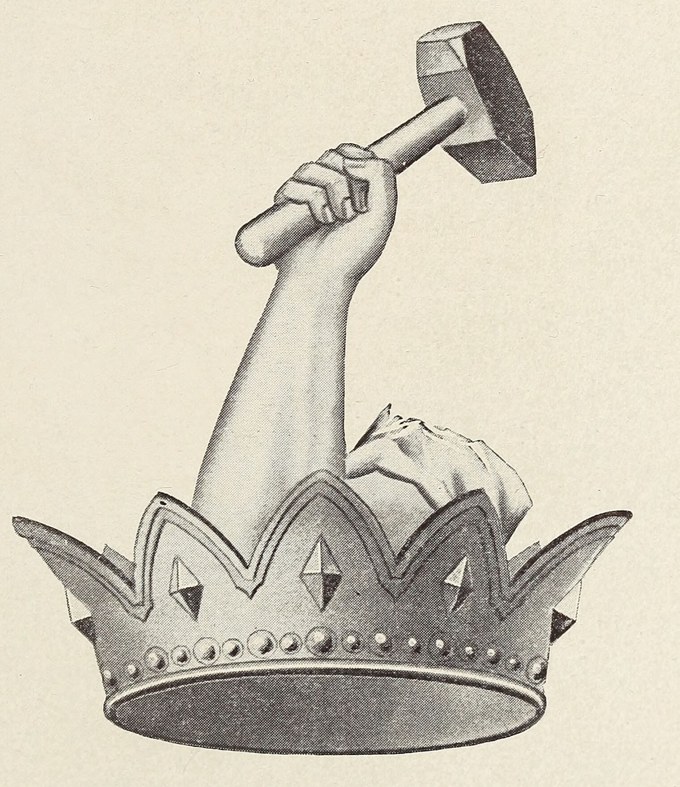
The company sold to the world. Before the Civil War it was exporting more than 150 distinct axe and machete patterns,S1 and its Legitimus mark — Latin for “genuine,” struck beneath a raised arm holding a hammer — became one of the most counterfeited trademarks in the tool trade, defended in court on both sides of the Atlantic.S1S7 That a mark was worth faking is the surest sign of what a Collins axe was worth.
Collins forged axes at Collinsville until 1966, when the works closed and Mann Edge Tool of Pennsylvania kept the Collins name alive.S7 For a collector, that long run is the challenge and the pleasure: the same marks ran for decades, so a Collins head is dated less by its shape than by its stamp — the presence of the Legitimus device and the exact wording of the Hartford address (see dating, below).
Documented offerings & facts
| Date | Attribute | Value | Source | Confidence |
|---|---|---|---|---|
| 1826 | Company founded identity |
Axe works established on the Farmington River at Collinsville (Canton), Conn. | S1 title & narrative | ✓ primary |
| 1828 | Trip-hammer forging introduced production |
~8 axes forged & tempered per man per day | S1 p. ~10–11 | ✓ primary |
| 1831 | Wholesale price, chopping axes◆ flagship price |
$20.00 per dozen (≈ $1.67 each) | S1 p. 11 | ✓ primary |
| 1831 | Largest early single order commerce |
1,500 dozen (18,000 axes) — Sampson & Tisdale, New York | S1 p. 11 | ✓ primary |
| 1841 | Factory price, chopping axes price |
$13.00 per dozen (≈ $1.08 each) — fell as mechanization spread | S6 | ~ corroborated |
| c.1835 | Annual production output |
~250,000 axes per year | S6 | ~ corroborated |
| Dec 1875 | “Legitimus” arm-and-hammer device first used trademark |
Legitimus = Latin “genuine”; raised arm holding a hammer | S1 p. ~26 | ✓ primary |
| 1859 | Enforced the mark against imitators legal |
Sued 30 manufacturers in England for using “Legitimus” | S1 p. ~20 | ✓ primary |
| pre-1861 | Distinct axe & machete patterns exported product breadth |
Over 150 different patterns | S1 p. ~25 | ✓ primary |
| — | Head-weight range offered spec |
~½ lb to 5¼ lb | S8 | ~ corroborated |
| — | Edge-steel method (“the Collins way”) construction |
Poll split and a tool-steel bit inserted deeply, then welded — not the cheaper lapped-over “overcoat” axe | S1 p. ~30 | ✓ primary |
| 1921 | Per-model weights, sizes & list prices product |
Full model grid — 1921 Collins Illustrated Catalogue (not digitized full-view) | S2 archival / facsimile | ⚑ to transcribe |
| 1899–1916 | How Collins reached market market structure |
Not listed by name in the mass retail / wholesale catalogs examined — those sold house brands instead | S3 S4 S5 | ✓ primary |
| 1966 | Axe production ended / works closed identity |
Collinsville plant closed | S7 | ~ corroborated |
“The business grew vigorously, and in 1831 the demand was such that the firm was almost swamped by its own prosperity. Prices were raised to $20 a dozen, but this only increased the sales. One big order of 1500 dozen from Sampson and Tisdale of New York, by far the largest the firm had hitherto received, pushed its capacity to the utmost.”— The Collins Company, One Hundred Years, 1826–1926 (Collinsville, 1926), p. 11 [S1].
Dating a head by its stamp — the collector’s first question
Collins used the same marks for decades, so dating turns on one divider and one detail: is the Legitimus crown-and-arm mark present, and how is the Hartford address worded. The Legitimus anchor is firm — Collins’s own book puts its first use in December 1875 (S1); the rest is a collector dating guide (S9) read against the corporate record.
| Era | What the head is stamped | What it tells you |
|---|---|---|
| 1826–c.1875 | Collins & Co. · Hartford · “Cast Steel Warranted” — no Legitimus | Pre-1876. The absence of Legitimus is the tell. |
| 1875–1966 | Legitimus: crown + raised arm & hammer over “LEGITIMUS,” with Collins & Co. Hartford | The core Collins era. ✓ first used Dec 1875 |
| 1930s+ | Collins & Company · Hartford, Conn. U.S.A. | The “U.S.A.” in the address = 1930s or later. |
| post-1966 | Often no Legitimus; small M stamped on the reverse of the logo | Mann Edge Tool continuation (Collins closed 1966). |
✓ Legitimus Dec 1875 from Collins’s own book (S1) · ~ stamp-wording evolution from a collector guide (S9).
| Year | Corporate name | Note |
|---|---|---|
| 1826 | Collins & Co. | Founded — Samuel W. & David C. Collins, William Wells |
| 1834 | The Collins Manufacturing Co. | Reorganized after financial difficulty |
| 1843 | The Collins Company | Reorganized again; name kept until closure |
| 1966 | Mann Edge Tool Co. | Collins closed; Mann (Lewistown, PA) kept the Collins name |
~ corroborated name changes from company histories (S10).
Put it together
- Collins & Co. Hartford Cast Steel Warranted, no Legitimus → pre-1876.
- Legitimus with Hartford, Conn. (no U.S.A.) → c. 1876–1920s.
- Legitimus with Hartford, Conn. U.S.A. → 1930s–1966.
- No Legitimus + small M on the reverse → post-1966 (Mann Edge Tool).
Registration — closed: beyond the Dec 1875 first use, the mark was federally registered — Collins & Co. Hartford / Legitimus, filed Oct 2 1934, USPTO serial No. 71356658, for axes/hatchets/adzes/machetes/edge tools (S11).
Documented axe patterns — from Collins’s own 1926 plate
Seven Collins patterns, each head struck with the Legitimus label, illustrated on p. 56 of One Hundred Years (S1) — verified against the page image. This plate establishes the model names; their per-model weights, sizes and prices live in the 1921 catalogue (S2).
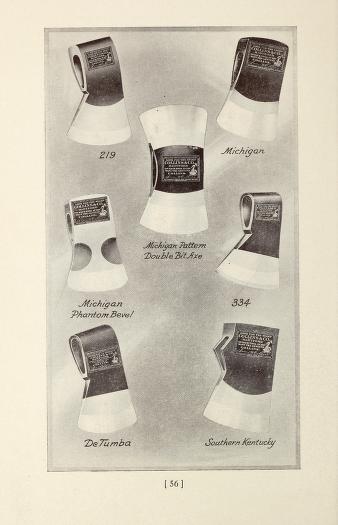
- No. 219 — single-bit axe (pattern number)
- Michigan — single-bit, Michigan pattern
- Michigan Pattern Double-Bit — double-bit axe
- Michigan, Phantom Bevel — single-bit, phantom-bevel cheeks
- No. 334 — single-bit axe (pattern number)
- De Tumba — felling pattern (Sp. de tumba; tropical / export)
- Southern Kentucky — single-bit, Kentucky pattern
Price over time — chopping axes, factory price per dozen
The 1831 and 1841 figures are Collins’s own factory prices per dozen; the 1921 Illustrated Catalogue (S2) fills in the full grid of per-model sizes and prices.
Why you won’t find Collins in the old mail-order catalogs
Reading the axe sections directly, the era’s giant catalogs carried private-label axes, not Collins: Sears’ Fall 1902 book sells “Red Ridge,” “Hunt’s Superior,” and “Hurd’s Razor Blade”;S3 Hibbard, Spencer, Bartlett’s 1916 catalog pushes its own “OVB” brand (its only “Collins” entry is an Eddie Collins baseball glove);S4 Russell & Erwin’s 1899 tools list “Germond’s Cast Steel” axes.S5 So Collins’s per-model price and spec record lives in its own catalogs and price lists (and the export trade), not the retail giants.
Read the full book at the Internet Archive →
In period print
Few American axes were talked about in the press as long as this one — from an 1845 stock list to a full 1853 factory feature to twentieth-century dealer ads that used the Collins name as the standard. Each quote was read on the original page; all are public-domain newspapers.
“the largest and most perfect establishment of the kind in the world”
A traveler’s feature on “Collins’ Axe Factory” — the Hartford stamp, the counterfeit warnings, exports to Cuba, Mexico and Peru.
Gallipolis Journal, Ohio (S12)
“Ask for them and take no other.”
The maker’s own card for “the justly celebrated brand of Sam’l W. Collins axes,” favorably known for fifty years.
San Marcos Free Press, Texas (S13)
“Have you seen the Collins Axe? It is made different.”
A front-page dealer ad leaning on the name alone — “High Quality.”
The Kendrick Gazette, Idaho (S15)
“Why does a farmer buy a ‘Collins’ Axe?”
Because such brands “are Standard and Recognized as Such” — Collins as the yardstick.
The Cordele Dispatch, Ga. (S16)
“an enviable reputation for many years”
A Tennessee paper’s notice of “the old reliable Collins axe.”
Clarksville Weekly Chronicle, Tenn. (S14)
“Collins Axes, Hoes, Spades and Shovels.”
A Mississippi merchant’s stock list — “Collins” was already a name to advertise by 1845.
The Port-Gibson Correspondent, Miss. (S17)
What a Collins is worth today — recent eBay sales
Sources
- primary · company historypublic domain
The Collins Company. One Hundred Years: A Brief Account of the Development of the Collins Company in the Manufacture of Axes, Machetes and Edge Tools … 1826–1926. Collinsville, Conn.: The Company, 1926. 62 pp. Internet Archive: onehundredyearsb00coll → - primary · manufacturer catalog
Collins & Co. Illustrated Catalogue of Axes, Hatchets, Adzes, Picks, Sledges, Hoes, Wrenches, Bush Hooks, etc., 1921. Definitive per-model source (weights, sizes, prices) — not digitized full-view; held at the Canton Historical Museum and others, and reprinted in facsimile by the Early Trades & Crafts Society. Canton Historical Museum →
⚑ Correction (2026-08-10): a prior draft mis-cited HathiTrust “Catalog 1920” (mdp.39015018391626) as a Collins catalog; inspection showed it is the Aladdin Company’s catalogue of kit houses. Retracted. - primary · market contextpublic domain
Sears, Roebuck & Co. Catalogue No. 112 (Fall 1902), Tools section. Internet Archive → - primary · market contextpublic domain
Hibbard, Spencer, Bartlett & Co. General Catalogue No. 61, 1916. Internet Archive → - primary · market contextpublic domain
Russell & Erwin Mfg. Co. Catalogue of Hardware, Vol. IX (1899), Tools section. Internet Archive → - secondary · lead
“World-renowned Maker of Axes: The Collins Company of Canton.” Connecticut History / CT Humanities. connecticuthistory.org → - secondary · lead
“The Legacy of the Collins Company.” Brant & Cochran. bnctools.com → - secondary · lead
“Collins & Co.” (biographical entry). The Davistown Museum. davistownmuseum.org → - secondary · dating guide
“How to Date a Collins Axe: A Step-by-Step Guide.” Tool Trip. — source of the stamp-wording evolution; key dates anchored on S1. tooltrip.com → - secondary · lead
“A Brief History of the Collins Axe Company.” Wood Trekker. — corporate name changes (1826 / 1834 / 1843). woodtrekker.blogspot.com → - primary · U.S. trademark recordpublic domain
“Collins & Co. Hartford / Legitimus” trademark — USPTO serial No. 71356658, filed Oct 2 1934 (axes, hatchets, adzes, bush-hooks, machetes, saws, chisels, knives); first-use claim traces to the Dec 1875 device. USPTO / Justia → - secondary · period newspaper featurepublic domain
“Collins’ Axe Factory” (feature). Gallipolis Journal (Gallipolis, Ohio), Nov. 10, 1853, p. 1. Library of Congress, Chronicling America → - primary · period newspaper advertisementpublic domain
Manufacturer’s advertisement for “Sam’l W. Collins axes.” San Marcos Free Press (San Marcos, Texas), Dec. 8, 1881, p. 3. Library of Congress, Chronicling America → - secondary · period newspaper reportpublic domain
News notice, “the old reliable Collins axe.” Clarksville Weekly Chronicle (Clarksville, Tenn.), Sept. 8, 1883, p. 3. Library of Congress, Chronicling America → - primary · period newspaper advertisementpublic domain
“Have you seen the Collins Axe? It is made different” (dealer advertisement). The Kendrick Gazette (Kendrick, Idaho), Jan. 5, 1906, p. 1. Library of Congress, Chronicling America → - primary · period newspaper advertisementpublic domain
“Why does a farmer buy a ‘Collins’ Axe?” (advertisement). The Cordele Dispatch (Cordele, Ga.), Mar. 3, 1918, p. 12. Library of Congress, Chronicling America → - primary · period newspaper advertisementpublic domain
“Collins Axes, Hoes, Spades and Shovels” (merchant’s stock advertisement). The Port-Gibson Correspondent (Port Gibson, Miss.), Sept. 17, 1845, p. 4. Library of Congress, Chronicling America →
← Other makers: True Temper / Kelly · Fayette R. Plumb · American Axe & Tool · Mann Edge Tool · Warren / Sager · Douglas Axe · Underhill Edge Tool · Emerson & Stevens · Snow & Nealley · Historic Axe Prices
↑ Home — all makers · Axe head patterns · About the author · How we source · Terms · Privacy · Disclaimer
Collins & Co. of Collinsville, Connecticut: the firm’s history and early factory prices, the documented pattern plate, and a stamp-dating key built on the Legitimus mark, and period advertising. Every figure carries a source and a confidence flag. Not affiliated with the Collins Company or any current rights-holder; all sources are public-domain documents or clearly-marked secondary references.