American Axe & Tool Co.
The "Axe Trust" — Glassport & Beaver Falls, PA · New York sales office
In 1889, fourteen major axe makers merged into one trust that controlled about half of all American axe production. Crucially, it kept its constituents’ old brand names — so this page is the guide’s Rosetta Stone: those anonymous “house brands” on the Sears-1902 page, and several True Temper lines, turn out to be American Axe & Tool brands.A1 When Kelly bought AA&T in 1921, they flowed onward into what became True Temper.
A short history
The American Axe & Tool Company was less a maker than a merger. In 1889 fourteen of the country’s major axe firms agreed to consolidate into a single trust — incorporated in 1890 — that at its height controlled roughly half of all American axe production.A10 It built a large new works at Glassport, Pennsylvania, which a paper of the day called “the largest of its kind in the world,”A7 plus a plant at Beaver Falls, and one by one it absorbed or closed the independents, from Underhill and Amoskeag to Douglas.A2
Its lasting importance to a collector is a single decision: the trust kept its constituents’ old brand names.A1 Hunt’s, Jamestown, Niagara, Blood’s, Lippincott, Red Warrior and the rest went on being stamped and sold as before — which is exactly why those names surface as “house brands” in the mail-order catalogs, and later in the True Temper line. For a generation the trust was the hinge the American axe trade turned on.
When Kelly Axe bought AA&T’s assets in 1921 the brands flowed onward — into Kelly, then American Fork & Hoe (1930), then True Temper (1949).A2 So an AA&T brand is a thread you can follow both ways: back to the independent that first forged it, and forward onto a twentieth-century True Temper head.
The makers who merged
The trust never published a roll of its founders, and no single surviving document names them all. What can be reconstructed comes from two kinds of evidence — a contemporary trade-journal account of the factories it was running, and the old brand names it kept stamping. Together they name most, though not quite all, of the firms that went in.
A dispatch in the Engineering & Mining Journal of September 5, 1891 caught the young combine at work: it “runs nine axe factories, situated respectively at Johnsonville and Gowanda, New York; Beaver Falls, Mill Hall and Bellefonte, Pa.; Douglass, Mass., and Cleveland, O.,” and “controls about half the production of axes in the United States.”A10 ✓ primary
The firms we can document. Each is tied to a period record or to the standard scholarship, listed with the works and brand it carried into the trust:
| Firm | Where | What it brought in | |
|---|---|---|---|
| Underhill Edge Tool Co. | Nashua, NH | the Underhill line — and the Amoskeag axe works it had absorbed back in 1879A13 | ✓ |
| Hubbard Axe Co. | Beaver Falls, PA | Hubbard’s Full Concave and Lippincott, the Pittsburgh interests; Beaver Falls became the trust’s first principal plant | ✓ |
| Robert Mann & Sons | Mill Hall, PA | the Robert Mann brand | ✓ |
| Thomas R. Mann & Co. | Bellefonte, PA | Thos. R. Mann and Red Mann | ✓ |
| James H. Mann & Co. | Yeagertown, PA | the third of the central-Pennsylvania Mann works to sign on | ~ |
| Douglas Axe Mfg. Co. | East Douglas, MA | the well-known Hunt’s axes; running as an AA&T factory by 1891, the plant closed in 1897 | ✓ |
| Johnsonville Axe Mfg. Co. | Johnsonville, NY | a principal works — one of the nine factories the 1891 report counted | ~ |
The 1891 dispatch also puts factories at Gowanda, NY and Cleveland, OH — two of the nine plants whose parent firms we can’t yet name with confidence.A10
Named in the trade, harder to pin down. These turn up on the 1894 brand roster or in collector records, but the firm behind the name isn’t cleanly documented — treat them as leads, not confirmed founders:
So — fourteen?
The exact figure is one the sources argue over. The standard histories say fourteen companies combined;A11 one axe reference puts it at “fifteen of the largest makers”;A12 the 1891 primary, counting plants rather than firms, tallies nine factories.A10 The neat fifteen-name lists that circulate online are unsourced, and they quietly fold in works the trust bought later — Isaiah Blood’s (about 1892) and Van Doren (about 1907) — so a few of the names are really leads rather than founders. The fullest modern study, if you want to go deeper, is Michael McBride’s The Axe Trust (2022).A14
Corporate genealogy
- 1889Fourteen major axe makers agree to consolidate — the “axe trust.” ~ A2
- Feb 1890American Axe & Tool Co. incorporated (Pittsburgh). ~ A5
- 1890New Glassport, PA factory; Underhill (which had absorbed Amoskeag in 1879) closes & moves its machinery there; a Beaver Falls plant on the former Hubbard Axe Co. site. ~ A2
- 1897Douglas Axe Mfg. Co. absorbed. ~ A2
- peakControlled ~50% of U.S. axe production; kept the old constituent brand names. ~ A2
- 1921Kelly Axe Mfg. Co. buys AA&T’s assets → the brands flow into Kelly → American Fork & Hoe (1930) → True Temper (1949). ~ A2
The brand web
From its own catalogue, the brands AA&T “manufactured” A1 — it kept the old names alive (gold = it reappears elsewhere in this guide):
| AA&T brand | Reappears as | ||
|---|---|---|---|
| Hunt’s | → | Sears 1902 “Hunt’s Superior Axes,” Yankee pattern, 56¢ | ✓ |
| Jamestown | → | Sears 1902 “Jamestown Axe,” 80¢ | ✓ |
| Niagara | → | Sears 1902 “Niagara Boys’ Axe,” 25¢ | ✓ |
| Hurd’s | → | Sears 1902 “Hurd’s Razor Blade,” Dayton, 55¢ | ✓ |
| Lippincott | → | Sears 1902 (Hubbard’s/Lippincott) & True Temper 1938 | ✓ |
| Blood’s | → | True Temper 1938 brand list (label: est. 1834) | ✓ |
| Red Warrior | → | Wm. Mann (Lewistown; Red Warrior label patented 1868) → AA&T → Kelly → True Temper (“Red Warrior = World’s Finest,” 1938) | ✓ |
| Wm./Robert/T.R. Mann | → | the Mann dynasty of central PA (Lewistown / Mill Hall) — see Mann Edge Tool | ~ |
That Red Warrior row is the whole story in one line: a single brand tracked from a Pennsylvania forge (patented 1868), through the trust, into Kelly, and onto a 1938 True Temper axe.
Dating a head by its stamp
| Era | What the head is stamped | What it tells you |
|---|---|---|
| 1890–1921 | American Axe & Tool Co., New York and/or the “Americanax” Indian-head oval | Made during the trust era. |
| 1890–1921 | A constituent brand (Hunt’s, Jamestown, Underhill, Blood’s…) with AA&T attributes | Trust-era production under an old name (vs. pre-1889 by the original firm). |
| post-1921 | The same names (Red Warrior, Blood’s, Lippincott…) but made by Kelly / AF&H | After Kelly bought AA&T (1921) the brands continued — so a later one is Kelly/True Temper. |
Datable label facts: Red Warrior was a William Mann (Lewistown) brand the trust carried — period dealers credited “Mann’s Red Warrior” — and Blood’s dated itself “established 1834.” ~ corroborated
In period print
The trust rarely advertised a brand under its own name — but as a company it was all over the trade and financial press. Each item below was read on the original page; all are public-domain newspapers.
“Manufacturers of Axes, Adzes, Hatchets, Mattocks, Picks.”
The trust’s own directory listing, from its New York sales office at 253 Broadway.
New-York Tribune (A6)
“the largest of its kind in the world”
A report on the new Glassport, Pa. works as it neared completion — the trust at full scale.
The Labor World, Duluth, Minn. (A7)
“decided to concentrate the plants”
The directors closing the old East Douglas, Mass. works in favor of Glassport — consolidation in action.
The Worcester Spy, Mass. (A8)
the axe “combine”
A trust-buster’s price table names the American Axe & Tool Co. as the company controlling axe prices.
Aberdeen Herald, Wash. (A9)
What an American Axe & Tool is worth today — recent eBay sales
The 1889 “axe trust” (Americanax, the Indian-head oval) consolidated fourteen makers and kept their old brand names — so clearly AA&T-marked pieces are only part of what it made.
Sources
- primary · catalogue (public domain)public domain
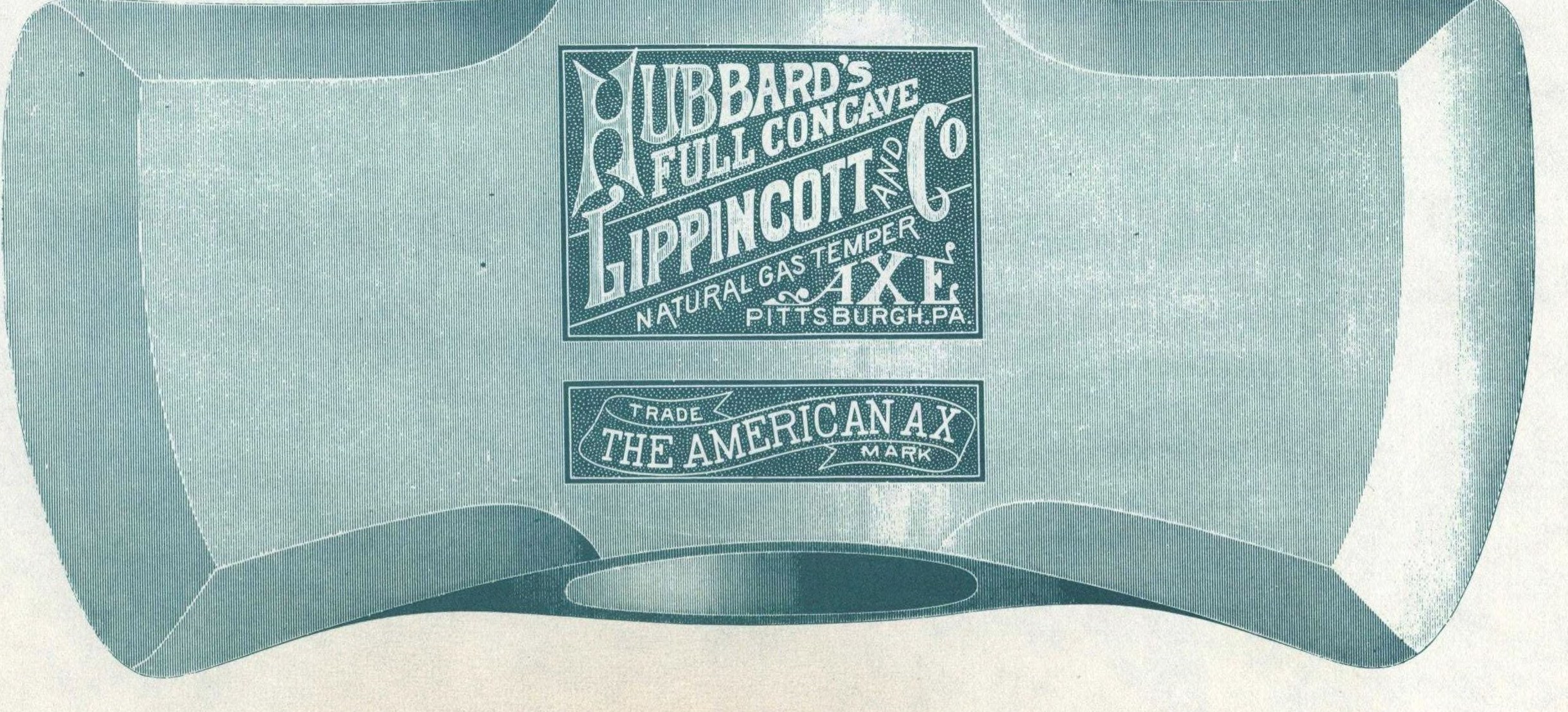
The American Axe & Tool Co. Illustrated Catalogue, 1894. Brand roster (p. 3) and the “American Ax” house mark on a Hubbard’s / Lippincott axe (p. 7), verified against the page images; specs, no prices. Public-domain scan. Internet Archive → - secondary · value/marks/history
“American Axe & Tool Company — Guide to Value, Marks, History.” WorthPoint Dictionary. worthpoint.com → - secondary · research site
“American Axe and Tool Company (A.A. & T. Co.).” Exploring Axe History. exploringaxehistory.com → - secondary · reference book (lead)
Paul Kebabian. American Axe & Tool Identification Guide. — the standard collector reference; use as a lead, cite primaries. - secondary · lead
“American Axe & Tool Company” (corporate dates). MyCompanies Wiki / Davistown Museum. mycompanies.fandom.com → - primary · period newspaper advertisementpublic domain
“The American Axe & Tool Company” (manufacturer’s directory advertisement, 253 Broadway, New York). New-York Tribune, Jan. 30, 1897, p. 55. Library of Congress, Chronicling America → - secondary · period newspaper reportpublic domain
“the largest of its kind in the world” (report on the new Glassport, Pa. works). The Labor World (Duluth, Minn.), Jan. 19, 1901, p. 3. Library of Congress, Chronicling America → - secondary · period newspaper reportpublic domain
Report that the directors would “concentrate the plants,” ending production at East Douglas, Mass. The Worcester Spy (Worcester, Mass.), Aug. 20, 1901, p. 4. Library of Congress, Chronicling America → - primary · period newspaperpublic domain
Anti-trust price table naming the American Axe & Tool Co. as the axe “combine.” Aberdeen Herald (Aberdeen, Wash.), June 4, 1906, p. 1. Library of Congress, Chronicling America → - primary · period trade journal (public domain)public domain
“The American Axe and Tool Company runs nine axe factories … It controls about half the production of axes in the United States” — and names the plants at Johnsonville & Gowanda, N.Y.; Beaver Falls, Mill Hall & Bellefonte, Pa.; Douglass, Mass.; and Cleveland, O. The Engineering and Mining Journal, Vol. 52, No. 10 (Sept. 5, 1891), p. 273; read in the full-text scan. Internet Archive → - secondary · scholarship
Jon P. Nelson, “The Mann Axe Dynasty of Central Pennsylvania” (2016) — for the “fourteen companies” figure and the central-Pennsylvania Mann firms joining the trust. Scholarship; primaries cited where they exist. - secondary · reference book
Allan Klenman, Axe Makers of North America, p. 130 (“… convince 15 of the largest makers in America to join together”), as quoted by the Davistown Museum. - secondary · museum research
Davistown Museum (H. G. Brack), maker biographies — Underhill Edge Tool Co. (Nashua, N.H.; acquired the Amoskeag Ax Co. in 1879, bought by AA&T in 1890) and Douglas Axe Mfg. Co. (East Douglas, Mass., 1836–1897). davistownmuseum.org. - secondary · reference book (lead)
Michael S. McBride, The Axe Trust: The Story of the American Axe and Tool Company (2022) — a book-length account of the firms that formed the company; the fullest modern study.
← Other makers: Collins & Co. · True Temper / Kelly · Fayette R. Plumb · Mann Edge Tool · Warren / Sager · Douglas Axe · Underhill Edge Tool · Emerson & Stevens · Snow & Nealley · Historic Axe Prices
↑ Home — all makers · Axe head patterns · About the author · How we source · Terms · Privacy · Disclaimer
American Axe & Tool Co.: the axe trust, its brand web (with cross-links verified against this guide’s other primary sources), and a stamp-dating key. A specs catalogue (no prices). Not affiliated with any current rights-holder; sources are a digitized public-domain catalogue and clearly-marked secondary references.